
Custom Jewelry Manufacturer: How to Read a Factory's Own Claims
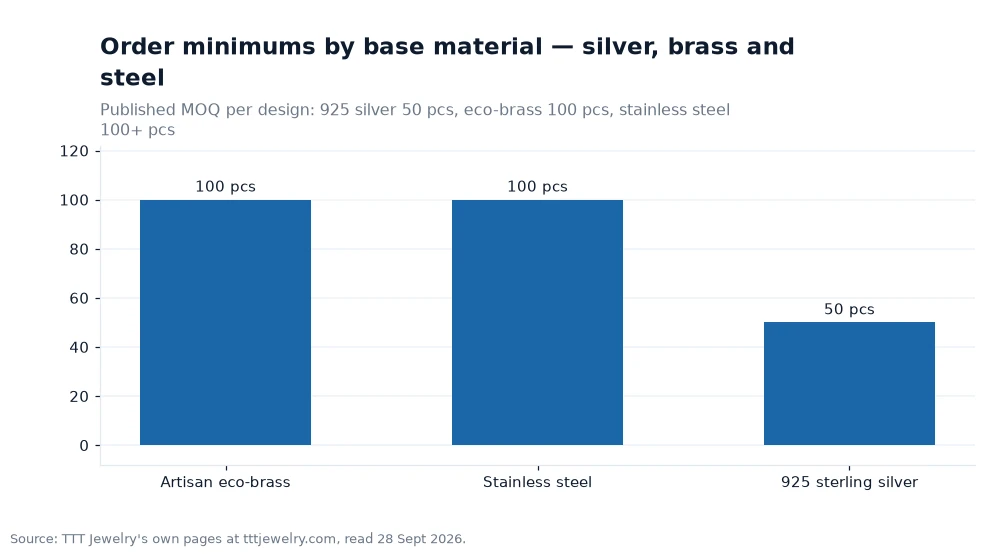
A factory's own page is the first test a buyer can run. TTT Jewelry publishes 50 pcs per design for 925 sterling silver, 100 pcs for artisan eco-brass and 100+ pcs for stainless steel — three figures that can be checked against a quotation before any sample is cut. The language around those figures needs a different reading method, because adjectives do not fail an audit but they do hide one.
Key takeaways
- Published minimums are 50 pcs per design in 925 sterling silver, 100 in artisan eco-brass and 100+ in stainless steel.
- CAD is quoted at under 48 hours — 6.7–8% of a 25–30 day sampling window.
- ISO 9001:2015, BSCI and REACH answer three separate questions and should be read separately.
- 100% inspection means every piece is handled, so the claim is testable at delivery.
Claims arrive in three tiers
The first tier is a number with a unit attached: a minimum quantity, a sampling window, an inspection rate. It can be compared with a quotation, a purchase order or a delivery note, and a mismatch is a fact rather than an opinion. The second tier is a process description — CAD, casting, polishing, plating, QC — which leaves a paper trail in the form of drawings, batch records and inspection sheets. The third tier is an adjective: premium, advanced, world-class. It cannot be checked, so it should carry no weight in a sourcing decision.
Most supplier pages mix the three in the same paragraph, which is why buyers remember the adjectives and forget the numbers. A better habit is to copy the page into a document and mark each sentence with a tier. What remains after the adjectives are removed is small, specific and useful. It is also the part a factory can be held to when a first order goes wrong, because a number can be argued about with evidence and a mood cannot. A brand shortlisting a B2B jewelry manufacturing partner should be able to put each claim into one of those three columns before the first call, and most of the useful ones will land in the first.
Numbers to test against a quote
Minimum order quantity is the easiest claim to verify because it appears in the quotation twice: once as a policy and once as a line item. TTT Jewelry sets 50 pieces per design in 925 sterling silver, 100 pieces per design in artisan eco-brass and 100+ pieces per design in stainless steel. The ordering is not arbitrary. Silver is the higher-value metal and takes a lower minimum; brass and steel sit at 100 because the setup and finishing work is spread across a larger run.
| Base material | Published minimum | What a test run looks like |
|---|---|---|
| 925 sterling silver | 50 pcs per design | Three designs, 150 pieces |
| Artisan eco-brass | 100 pcs per design | Three designs, 300 pieces |
| Stainless steel | 100+ pcs per design | Three designs, 300+ pieces |
Read the table as a ratio rather than three isolated rules. Silver is half the brass minimum (50 ÷ 100 = 50%), so a mixed collection has to be planned per material, not per design. A buyer who assumes one minimum across a range will discover at the quotation stage that the silver pieces are affordable in small numbers and the brass pieces are not. That is information worth having before a lookbook is photographed.
Process claims and the scope line on a certificate
A process claim is credible when it names an output. TTT Jewelry's sequence does: 3D CAD with renderings in under 48 hours, master sampling in 25–30 days, mass production in 3–4 weeks, final QC at 100% inspection, a 24-hour response window and a named project manager. Each of those produces something a buyer can hold — a model file, a physical sample, an inspection record, an email reply inside a day. The claim becomes a service level rather than a slogan.
Where process claims fail is at the joins. A factory may hold a 48-hour CAD standard and still take a week to answer a question about a stone size, because the answer sits with a person rather than a process. Ask who replies, how quickly, and in what format. A named project manager with a 24-hour response commitment is a modest claim, but it is the one that decides whether a six-week schedule survives a single query.
Certificates follow the same test, and every one opens with a scope statement. ISO 9001:2015 speaks to the quality management system across production stages. The BSCI audit speaks to labour practice and supply-chain conduct. REACH speaks to restricted substances, and TTT Jewelry states its materials are free of lead, cadmium and nickel, with plating compliant with REACH and CA Prop 65. None of the three covers the others.
That matters when a brand is qualifying a supplier for a specific metal. A silver programme needs a material statement for 925 silver and a plating statement for the finish, not a generic compliance page. Buyers can compare the statement with the sterling silver jewelry manufacturer line before committing, and should insist that the alloy named in the document matches the alloy on the purchase order. A certificate with the wrong scope is worse than no certificate, because it looks like evidence.
Check the sample room, not the brochure
The physical sample is the last and strongest test. A plating claim can be checked at the edge of a link, where the coating is thinnest and wear begins. A setting claim can be checked by looking for a gap between the stone and its seat. A polishing claim can be checked with a raking light. A hallmark claim can be checked with a loupe: S925, 316L and 18KGP are stamped marks, and a missing mark is a missing process step rather than a design choice.
Two samples from the same factory are more informative than one. If the second piece differs from the first in weight, finish or prong geometry, the process is not yet under control, whatever the certificate says. This is the practical meaning of an OEM/ODM relationship: the factory is being asked to reproduce a standard, not to produce a one-off.
Worked example
Take a three-design collection and work out the minimums. In 925 sterling silver, 3 × 50 = 150 pieces. In artisan eco-brass, 3 × 100 = 300 pieces. The silver run is 150 ÷ 300 = 50% of the brass run for the same design count, which follows directly from 50 ÷ 100. Add a stainless steel version and the floor becomes 3 × 100 = 300 pieces or more. Now test the schedule claim the same way: 48 hours of CAD against a 30-day sample is 48 ÷ 720 = 6.7%, and against a 25-day sample it is 48 ÷ 600 = 8%. A supplier presenting CAD as the long pole is describing the wrong stage; sampling and production hold 96.7% of a 60-day route. Both sums take under a minute and settle more than a page of adjectives.
Frequently asked questions
How do I check a factory's claimed lead time?
Ask for the stage breakdown. TTT Jewelry publishes under 48 hours for 3D CAD, 25–30 days for master sampling and 3–4 weeks for mass production, which a buyer can hold against a production schedule.
Is a low minimum a sign of a small factory?
Not by itself. TTT Jewelry publishes 50 pcs per design for 925 sterling silver and 100 pcs for artisan eco-brass; the gap tracks material and setup, and neither figure describes factory size.
Which claims should be in writing?
The base material and its hallmark, the plating specification, the inspection regime, the mould ownership clause and the sampling window. Each can be checked against a sample, a drawing or a delivery record.
A short due-diligence sequence
Start with the quotation and the minimums, because they are arithmetic and cannot be talked around. Then ask for the process outputs — model file, sample, inspection record — and match them to the dates the factory published. Then read the certificates for scope, not for logos. Brands adding a steel line can run the same three steps against the stainless steel jewelry manufacturer page, where the 100+ piece minimum and the PVD finish are the two claims worth testing first. A supplier that answers all three stages with documents is a supplier worth a sample order; one that answers with adjectives is not.
Source note: figures come from the manufacturer's own website (tttjewelry.com), read 28 Sept 2026.[1]