
Documents and Compliance for a Travel Retail Fragrance Launch
The document request usually arrives by email, in a list, with a date attached. It is the moment when a fragrance launch stops being a product question and becomes a compliance question, and it is much easier to answer if the documents were planned rather than assembled under pressure. The items on a travel retail list are not arbitrary: each one links a claim to a product, a pack, a batch or a site. Buyers who understand what each document connects to can build the set once, in a form that satisfies several markets, instead of rebuilding it market by market as each listing approaches.
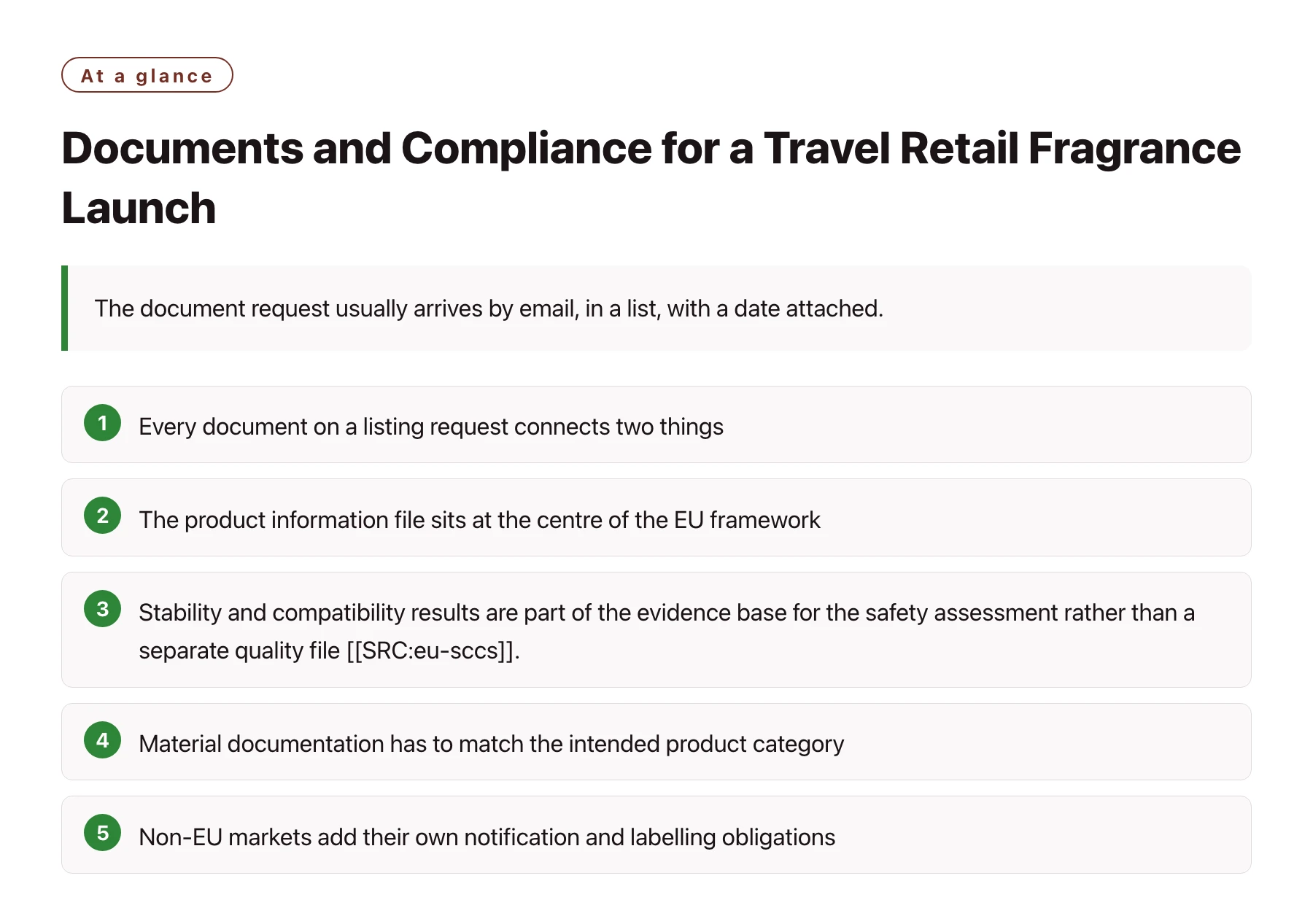
Key takeawaysEvery document on a listing request connects two things, and a document that cannot show its connection is the one that causes a delay. · The product information file sits at the centre of the EU framework, pulling together the safety assessment, the formula, the labelling and the manufacturing information [1]. · Stability and compatibility results are part of the evidence base for the safety assessment rather than a separate quality file [2]. · Material documentation has to match the intended product category, because restrictions depend on how the product is used and how much of a material it contains [3]. · Non-EU markets add their own notification and labelling obligations, so the market list should be settled before artwork rather than after [4]. · Certificates belong to a site and a scope, not to a brand, and they should name the facility that will actually make the product.
Compliance work has a reputation for being repetitive, and the repetition is real, but it is not arbitrary. A listing request is a series of attempts to answer four questions: what is in the product, is it safe as used, does the pack present it lawfully, and who made it. Each document is a different piece of evidence for those four questions, and each becomes much easier to produce when the underlying decisions were fixed early.
The practical difficulty is that the requests arrive at different times. A retailer asks for one set, an importer asks for another, and a new market asks for something the brand has never been asked for. The brands that cope well treat the document set as a single asset with market-specific additions rather than as a fresh project each time.
What follows is the document set, grouped by who usually asks for it, with a note on what each item has to link to in order to be useful.
The document set, grouped by who asks for it
| Document | Who typically asks | What it has to link to |
|---|---|---|
| Formula and ingredient information | The safety assessor, and any party preparing a notification | The exact formula version, including the concentration of restricted materials |
| Safety assessment and product information file | The market authority or the responsible person holding the file | The formula, the pack, the labelling and the manufacturing site for that product [1] |
| Stability and compatibility results | The safety assessor, the retailer, and sometimes the importer | The specific juice and pack combination tested, with conditions and duration [2] |
| Material compliance statements | The assessor and buyers with their own restricted-substance policies | The intended product category and the level at which the material is used [3] |
| Label artwork and market statements | The retailer, the importer and each market's notification process | The market list, since the strictest label requirement usually governs the print run [4] |
| Manufacturing certificates | The retailer's vendor onboarding team | The specific site, the standard, the scope and the validity period |
| Batch records and retained reference | The quality team on a reorder or a complaint | The batch number on the shipping documents and the reference used for release |
| Packaging and material declarations | Retailers with packaging policies, and some markets | The actual components supplied, including decoration and secondary packaging |
The third column is the one buyers skip. A document without its link is a page of paper; a document with its link is evidence. When a request arrives, the fastest route through it is to sort the list by what each item has to connect to.
Where document requests go wrong
Most delays are caused by a mismatch rather than a missing file. The stability report exists but covers a different pack. The certificate exists but names another facility. The formula sheet is current but the artwork was designed against an earlier version. These mismatches are invisible until someone reads the documents together, which is why the useful discipline is to read them that way before sending them out.
The second common failure is timing. Documents that depend on decisions cannot be produced before those decisions are made, and a market list finalised after printing will produce a labelling problem that no letter can fix. The order of operations matters more than the volume of paperwork.
Certificates need reading, not collecting
A certificate is a statement about a site, a standard and a scope, valid for a period. When a manufacturer's public material describes its certification position, as a page covering its background and certifications typically does, that description is a starting point for the conversation rather than the evidence itself. The questions worth asking are which legal entity holds the certificate, which facility it covers, what the scope excludes, and when it was last assessed. Those answers are usually available immediately, and the speed of the answer is informative.
The pack is part of the file
Buyers often treat packaging as a commercial matter and compliance as a product matter. In practice the pack is inside the file: the materials in contact with the product, the decoration, the closure and the labelling all have to be consistent with what was assessed. A late substitution of a pump or a coating is therefore not only a production change but a documentation change, and it should be treated as one.
Building the set once for several markets
A brand selling into more than one country can save substantial effort by designing one document set and treating market differences as additions. The core set covers the formula, the safety assessment inputs, the stability and compatibility results, the site certificates, the batch records and the labelling rationale. Market-specific items are then layered on: a notification for one jurisdiction, a language requirement for another, a specific statement for a third.
This approach has a second benefit. It makes the brand's own obligations visible. A brand that understands which documents it must hold and which it is entitled to receive from its manufacturer can plan the internal work rather than waiting for a retailer to explain it.
It also clarifies what to ask for from the outset. A manufacturer that already operates across multiple markets will be able to describe the additions it routinely handles, and one that describes its scope publicly, as Xuelei's official site does, gives a buyer enough context to ask a precise question instead of a general one.
If the document set has to be reduced, reduce the number of decisions it depends on rather than the number of documents. One pack list, one market list and one frozen formula make every item on the list easier to produce and harder to dispute. Partners that operate as a contract manufacturer for perfume brands rather than as a filler alone usually have a standing answer for what they will provide, and asking for that answer before the order is placed turns compliance from a scramble into a checklist.
Sources
- European Commission: Cosmetics in the EU —— The European Commission's overview of EU cosmetics rules, including the responsible person, product information file and safety report requirements.
- EU Scientific Committee on Consumer Safety (SCCS) —— The EU scientific committee that issues opinions on the safety of cosmetic ingredients, including fragrance allergens and their labelling thresholds.
- IFRA Standards Library (International Fragrance Association) —— The IFRA Standards Library lists the restrictions the fragrance industry applies to individual fragrance ingredients, based on safety assessments; it is the reference point for compliant fragrance formulation.
- Health Canada: Cosmetic Safety —— Health Canada's cosmetics pages, covering cosmetic notification, the ingredient hotlist and safety requirements for cosmetics sold in Canada.
Frequently asked questions
Who is responsible for the product information file?
Under the EU framework the responsible person placing the product on the market holds the file, which means a brand selling under its own name normally carries that obligation. The manufacturer supplies the underlying information, but the file itself belongs to the party responsible for the product, which is why brands should understand the document set rather than assume it arrives complete.
Do I need separate stability reports for every market?
Usually not, provided the same product and pack are sold. One study on a defined combination can support the same claim in several markets, subject to each market's labelling requirements. A separate report is needed when the product, the pack or the claim differs, not merely because the destination changes.
What should a manufacturer provide without being asked?
A manufacturing partner should be able to provide site certificates with their scope, batch records for the product supplied, retained reference details, and the technical information needed for the safety assessment and labelling. Brands should still ask, because the format and timing of those handovers vary and are worth agreeing in writing.
How early should the market list be fixed?
Before artwork is approved, and ideally before the pack list is finalised. Several obligations, including notification and specific labelling statements, depend on where the product will be sold, and the strictest market usually determines the printed version for every unit. Fixing the list late converts a design decision into a reprint.
Are material statements the same as a safety assessment?
No. Material statements document how restricted substances are handled against limits that depend on product type and use level. The safety assessment is a broader judgement about the finished product as used. The first feeds the second, but they are separate documents produced by different processes and often by different parties.
Continue browsing the The Card Chest editorial desk.